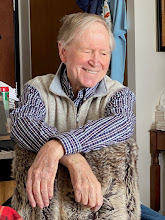
Watching It Happened One Night on Turner, I recalled my sister Mary Virginia’s love of Clark Gable. I recall Mary V. -- "Sadie" -- who at the last of her life referred to me as her “baby brother.” I think she was pretty fond of me, which I always took for granted but did less so as the years went by. I know while growing up I idolized her as smart, funny, pretty, and successful. All of which she was.
Another event that prompted my nostalgia over My sis was the recent passing of the great World War II-era singer, Jo Stafford. Mary Virginia and I were fond of "G.I. Jo," whose beautiful, clear voice graced many hits of the days of Frank Sinatra and the Pied Pipers (Jo was one of them for several years). We laughed at Jo's mock hit, "Tem-tation." (You'd have to hear one of the original versions of that tune to appreciate her parody fully.) Of course, there is no disputing taste, but I think Sadie and I had unimpeachable taste in our love of Jo Stafford. Maybe Sadie and Jo have had the opportunity to meet at last.
Wednesday, July 23, 2008

Monday, September 17, 2007
Let's Go to the Slide! Aimlessness
When was it? Forty-two years ago? Or 44. Before I went to the Peace Corps. It must have been afterwards. Bud would put it to me: "Let's go to the Slide!" It must have been in the summer of 1965, after I got back from Ibadan and D.C. and Indianapolis and Tucson and El Paso and Ciudad Juarez* and Las Cruces and wherever in hell else I meandered that aimless year.
That's about all I remember from those trips to the Hillside Hotel cocktail lounge. Warm, sweaty nights with crickets and things. I recall one night when we were there a guy passed out and put his head on a table. John David Lucht, the owner of the bar and the bartender, with a white short-sleeved shirt and black necktie there night after night (Bud and I were there night after night and we knew how faithful John David was to that job), needed the table and he leaned the passed-out drunk on his chair up against a wall and took the table for some more genteel clients and they didn't mind and John David didn't mind and the drunk didn't mind and it was funny. Reminded me of the corpse in "The Real Inspector Hound" or Bernie in "Weekend at Bernie's." We laughed quietly and politely and went on with our merriment. The guy slept it off the entire evening we were there. He might still be there. Bud knew how to pick what my mother referred to as "saloons." We'd sit in the lounge and look out the window at night and it was a nice view, kind of like San Francisco -- I've sat in bars in Frisco and looked out at the night lights too. That's about it. Just a reminiscence.
We'd plummet down that little hill after a beery night (for me: Bud drank manhattans) and drive home in the still darkness hours in little old Madison (we both slept at our parents' house that summer) and sleep it off and the next day would come, and we were young and all of us were alive -- both parents and I had no idea that the old man had a bad heart (actually not a bad heart but blood vessels like mine, clogged up with plaque, and there was no Plavix then and no CABG) -- not thinking about croaking, you know, and life was damned good.
I'd have bacon and eggs next morning as soon as I could tolerate them and those were the days I'd do two drunks a day: I liked to take off shortly after noon to a bar in Chelsea, a "wide place in the road" en route to Louisville, beyond Hanover, in the early afternoon, where I would drink three or four beers, and then come home and sleep it off. I recall driving back from the "3-N-1" one afternoon and encountering some joker who was driving on the left side of the road. Just for the hell of it, I reckon. I got off the road and let him go by. Crazy somebitch.
Then there'd be the evening of drinking with Bud at the "Slide." He wouldn't go to the redneck places like the Crown Room. I would go there and because of my big stupid mouth would come close to getting the shit kicked out of me. Them t'backer farmers/factry workers liked to fight. Don't know why I went to that shit-kicking place. The sweetheart of the jukebox was Brenda Lee. I did/do despise her singing. No Anita O'Day, it goes without saying. Or Roberta Peters singing the "Queen of the Night" aria from Die Zauberfloete. Finally I got a job as a biochemistry lab tech at Muscatatuck and my wild-assed drinking continued in Miller's Tavern in North Vernon and in a dorm on the campus there. The to-be superintendent and I enjoyed getting fucked up in that saloon. It is my recollection that he was removed in disgrace later on. I believe the same principle applied to this chap as to me: One should not attempt to manage other people when one cannot manage oneself.
More reminiscences to come. Gentlemen: Goodnight.
* In that city across the Rio Grande from El Paso I met an incredibly beautiful Mexican woman. I'd marry her in a Madison minute if I had the perspective then that I have now. Now, I know which women are the keepers. I was too young and callow to marry anybody then and, to my credit, I knew it. I hope this lovely muchacha got out of that hellhole she was in. I hope she is alive and well and now a great-grandmother and prosperous and all her family is prosperous. She was a righteous lady. Vaya con dios, amigos y amigas.
.
Wednesday, August 15, 2007
Capriccio Italiene by Tschaikovsky
By golly, I can spell! The three words in the title above are all acceptable spellings. There are variations in the transposition of the Cyrillic alphabet to the one we use in English, so some folks spell the surname of the composer, Peter, son of Ilya, differently. Anyhow, I'm listening to Tschaikovsky's Italian Caprice right now from Minnesota Public Radio, resurrecting the memory of my sojourn 49 summers ago at Fort Leonard Wood, Missouri. God, how I wish I were there and it was then! Just for a little while, just a short while: the smell of the smoke of Camel cigarettes and Kiwi shoe polish, the evening sun coming in the unshaded barracks windows, the sarcastic banter I traded with Stavins, the lawyer from Chicago, and the music emanating from his portable 33-and-a-third, either Cappricio Italiene or the 1812 Overture. How I wish I were there and it was then!
Wednesday, August 8, 2007
This Date in 1974
August 8, 1974. It is my recollection that I was on my way back from New England to Columbus, Indiana in a 1973 gray Pinto two-door sedan. I heard on the radio of the resignation of Nixon. By the time I got home to our house on Newton Street in Columbus, Indiana, Gerry Ford was president. Hillary Clinton was shy of 27 then, Barack Obama was 13. Irwin Miller was 66. Kurt Vonnegut Jr. was 52. I was 35.
I think that was about the last time I tried to run away from my duties as a husband, father, and provider to the three I was then responsible for: a wife and twins, a boy and girl then not yet three years old. Oh yes, I'd tried to run away before that.
I'd been employed as the public relations flack for a small college in Ohio up to the time that I walked out, got in the Pinto, and headed east through Pennsylvania and finally to Providence, Rhode Island. An unusually dry, cool batch of weather prevailed in those parts and I remember eating a lobster-salad roll on Narragansett Beach on a sunny afternoon with blue sky and pellucid air that is not usually found next to the Atlantic Ocean. And it was autumnally cold. I spent that night in Providence, going to a certain meeting where there was a man who looked like Paul Newman, spoke with that New England accent so different from my own, and seemed hostile because he was clearly the cock of the henhouse and perceived me as somewhat of a cock myself. I headed back to Indiana the next morning.
It was good to be back home, although like Lucy I had some 'splainin' to do. I got off easy, as I had all my life. No toilet-training at gunpoint for me as the indulged little brat I was, and here I was still making messes that others had to clean up. So what is new?
That was a sweet little neighborhood. There was a lady next door to us who was known as "T," for her last name, which was slightly "ethnic" compared to the short Anglo names of most of southern Indiana such as Long, Hall, Hill, Gray, Lee, and other such monosyllabic, prosaic appellations. First time I met T in the alley between our houses, she cautioned me that she didn't "neighbor much." OK. Then she fell in love with those twins and so much for that. The Flecks and their kids lived just across the street and the Hill kids were up the block.
Newton Street had little traffic and the next summer Natalie would teach herself to ride a bicycle on the street in front of our house. Seems like it was always summer there, mild and hazy and humid and calm. We'd have home-made ice cream and gatherings at dusk with the neighbors and every now and then we'd haul ourselves off to our relatives in Seymour or Petersburg. We also had an ice storm once and some scary thunderstorms. I was afraid of tornadoes and was grateful for the excellent basement of that house. That was the year in April that we'd had a Homeric outbreak of tornadoes and I'd seen the laying waste of the town of Xenia, Ohio. That killing field inspired awe, to say the least.
But then a beautiful autumn ensued. Cummins gave me back my sinecure and we had a nice Xmas and then 1975 brought on its cataclysms in which I went from being a drunkard to being a counselor of drunkards. (Again.) Onward and upward.
Anyhow, August 8, 1974 was a good day, all in all. The prodigal returneth once more.
Friday, July 27, 2007
This Day in 1953 (July 27)
A moment ago I read a NY Times article from this day in 1953: the signing of the treaty between North Korea and the United States. The parties met and signed in silence, and the prediction by many then was that the truce would not last, but somehow we or they have not broken it.
But the Cold War was a grim affair that ground on, and in a way there is now and always has been a cold war in this world. Where there is not a hot one. God! We are a warring lot.
II. Seize the Day. Didn't finish this on the 27th, so here it is the 28th. As the newsreel of that 1953 day no doubt intoned (through the theatrically thunderous, doomsday voice of Westbrook Van Voorhees), "Time Marches On."
What was I going to write? Every time I start to write a retrospective, I think of Kurt Vonnegut's words in one of his fiction-nonfiction curiosities, "Just an old fart with his memories and his Pall Malls." Don't have the Pall Malls (praise God!) but those memories are indeed precious as they get mellower and mellower, and I suppose they gradually become all that an old man (or woman) (or fart) has. The realities of the present day are grim enough and for me growing grimmer by the day.
On the day of that armed truce between the UN and Communist North Korea in 1953, I was one month past the magic age of 14. Let's see: that was the summer between my freshman and sophomore years of high school. ["Sophomore": roughly, "wise moron"] I'd begun to sprout a little, was preoccupied with my complexion, voice, etc. [Voice didn't change until after the mandatory auditions for the choral club, into which I was happily drafted the next year as an eleventh grader. But as usual I get ahead of whatever story a discourse might contain.]
I don't recall anything specific of that day or even of that summer. I could go to the library microfilm and find out what the weather was here in Happy Valley. The impressions I have had of that day in Korea was that there was great darkness, as there was the day in Jerusalem when Christ was crucified. The Cold War was to continue for most of the rest of the twentieth century, and Korea is still divided into two hostile factions at the 38th parallel. (For the record, the latitude of Madison, Indiana is 38 degrees, 45 minutes -- the exact position of the 38th parallel at this longitude is a ways south of Frankfort, Kentucky; but the 38th parallel here roughly approximates the Mason-Dixon line, or as somebody once dubbed it, the Smith-Wesson line.)
I suspect, though, that the weather here in late July 1953 was about like it has been here at present: warm, humid, with that blue film on the green hills in the distance, and mostly sunny enough to cast a shadow from a pale blue sky above.
We had no a-c in that little shotgun frame house, but the house was well insulated, Mother Vi kept it closed up and dark, and somehow it worked. I don't recall that we even had a damn fan, but we somehow managed to keep relatively cool. Daddy Noble was now working as an insurance salesman, Mother was a babysitter and kept her earnings in a baby sock between her cleavage.
Bud had graduated from high school and was getting ready to go to IU. He flipped burgers and washed dishes at the Stop Lite Grill, was an usher at the Ohio Theater, and I think he even managed to get some construction work with incredible money and a hellacious sunburn. Funds from Vi's sock provided extras, clothes, etc. Anyhow, all of the first year at Indiana University was paid for in full. And I didn't see much of him that summer.
For work myself, I carried newspapers and caddied at the country club. I made visits to Auntie and Sister Sadie in Indianapolis, traveling there on the trusty old White Star bus, a Flxible that was as much of a workhorse on the road as the DC-3 was in the sky. Many of those Flxibles are still rolling, many now rebuilt and appropriated for family RVs. We had public transportation then from burgs like Madison; we even had a B & O passenger train that ran between Cincinnati and St. Louis, alongside US 50, which passed through North Vernon and Seymour. I don't recall any RVs then, but a few silver Airstream trailers were around, enough that we little people weren't too puzzled at the idea of Lucy and Desi honeymooning in one in "The Long, Long Trailer."
Linn and Sadie lived in a paint-peeled, gray frame house with Grandma Josie Hudson in the Irvington neighborhood of Indianapolis, a little ways off East Washington Street. I was amazed at how pleasantly wooded it was there. Squirrels abounded! There was a city park and I think a municipal eighteen-hole golf course that was cheap enough for common folk to play. (Yes, socialism existed in the dead center of Indiana! The course, of course, has been sold to Rupert Murdoch or some other capitalist rat bastard since then, I conjecture.)
I wish Bud were here to correct me if my memory fails me, but I believe I visited them at that house during that summer. I recall images from then but not a lot of "hard data." Grandma Josie looked very old-fashioned: she wore her hair in a bun, just like my Grandma Annie did. I was very impressed with the Hudsons' conspicuous consumption. They had a big window a-c and a roomy refrigerator that had ice cream in the freezer at all times. Sadie was carrying in utero the person who would become John Evans Hudson the following October. She smoked like a chimney during both of her pregnancies but had healthy and also beautiful children in spite of it. I was playing with tobacco myself then: I would be a confirmed smoker in another year.
In case you, dear reader, are not aware of it, there is no point to this rambling. "Just an old fart with his memories ..."
To Happy Dog Days. Then and now.
Tuesday, June 5, 2007
Thirty-Nine Years Ago
Thirty-nine years ago today, Bobby Kennedy, frontrunner for the Democratic nomination for President (capitalized this time), was murdered. He'd just made a statement proclaiming victory in the California primary and was leaving the Ambassador Hotel in Los Angeles via the kitchen. There, a man named Sirhan Bishara Sirhan shot Bob in the head. The second Kennedy who was a public servant and victim of an assassin in less than five years died twenty hours later.
I was in L.A. when that happened. The news, including a video of the event, was on the eleven o'clock news. I remember the shot, the screams, the struggle, the confusion as bodyguards, including Rosie Grier, the football star, wrestled Sirhan to the floor and disarmed him. ("Get that gun away from him! Break his thumb if you have to!" someone yelled at Rosie. Rosie got 'er away and didn't break Sirhan's thumb.)) As has always been the routine, they showed the tape over and over and over.
A few days later I was at a job interview next to the LAX airport and from (ironically) a knoll above the road on which a two-vehicle procession arrived, I watched. In the distance on the tarmac was Air Force One -- a Boeing 707 then -- I'd ridden in one of those airworthy ships to Nigeria as a Peace Corps Volunteer a few years before that -- waiting for the remains of RFK, in a huge black hearse, followed by Ted Kennedy and Ethel Kennedy in a huge black limousine.
I saw the two famous Kennedys remarkably clearly in that car that day. It occurred to me long afterward that still a third gunman would have had an easy shot at the third brother then and there. No one was there to protect their slow approach, at least no one I was aware of. My recall is that I stood there alone. For all I know I was in the crosshairs of a government sniper's rifle right then, lest I should turn out to be another of those weirdos who was looking for his fifteen minutes of fame instead of the harmless loser drowning in alcohol that I was, honest-to-god ignorant of the procession I happened on.
In retrospect I envision a mural: brightly colored, a landscape on, say, an adobe wall in downtown Los Angeles. On the left, the two official cars, Teddy with his huge shaggy-haired head downcast, Ethel with her sorrowful face turned up to the strong daylight of the desert next to the ocean that is the L.A. basin. On the right, the behemoth silver-and-blue airship somehow nearly dwarfing the vast tarmac. Brightly colored but surreal, except for the two mourners (and the lone unobserved observer above and at a distance from them) absolutely devoid of humanity, absolutely desolate. Desolation in a desolate nation.
That was 1968, desolation in a desolate year.
I feel as though we are in such a year now.
Wednesday, April 25, 2007
Memoir of Uncle Bill
I still have this mental picture of him in a "charcoal-green" (it worked) wool suit -- and a hat. In 1958 men were still wearing suits with dress shirts and neckties, and hats, to work every day. Although Bill was only thirty-five then, the impression of this writer, a boy of nineteen at that time, was that he was "middle-aged." He wore glasses all the time, he was "heavy," and he told me that he wore trousers only with pleats to hide an "old man's pot." (Pleats on the front were passe then -- youthful slacks also had buckles -- "heinie-binders" -- on the backs.)
He lived on the south side, near 79th and Racine, in a flat on the top floor of one of those myriad brick apartment buildings with wooden porches on the backs that abound in Chicago. He had a wife named Nancy and a red dachshund named Oscar. (I never gave a thought to the canine name until years later: Oscar Meyer, the wiener dog.)
Nancy and Bill both worked in the Loop when I first showed up there in October 1958. They rode a train (I forget the line; at that time the CTA el came only to 63rd). I stayed briefly with them and then went back to Johnstown and recruited a friend and fourth cousin on my father's father's side of the family, who I will refer to as Jim Dandy. (His name is not far from that.) Jim and I sought and immediately found jobs. "If you can't get a job in Chicago, you can't get a job anywhere," Bill liked to say.
I'd been discharged from my sunshine soldier status (six months' active duty) in October. Bill had cheered and encouraged me during that sojourn at Fort Lost in the Woods, in the Ozark mountains of Missouri, every last damned one of which I'd marched up but never down. I'd been scared by all this apocalyptic horse shit and was afraid I'd be frozen on active duty and end up on that Armageddon battlefield as a poor little dogface who wasn't even a good shot with one dinky little M-1 rifle. Bill said, come now, it's not as bad as all that, Dulles and Krushchev will keep playing chicken with their brinksmanship but the Russians really aren't stupid enough to start it. (And that was in the days when we Americans, at least the naive ones of us, which sure as hell included me, were reasonably certain that we weren't going to invade a sovereign nation.) Anyhow, Bill and I carried on a warm and hilarious correspondence while I was there; summer came with lots of sunshine and exercise and good food and drills and reading Modern Library books and listening to LPs of classical music and PX three-two beer. Well, that beer turned out to be a problem, but more on that later.
Anyhow, back in mufti in the Big City, we set ourselves up in a slummy apartment north of the Loop near a subway entrance and next door to Jazz Unlimited, a night spot that featured Jonah Jones and his band. He played a muted trumpet and I thought his music was pretty monotonous but he was hot in Chicago then. (Somehow I heaped him in the same category as Ferrante and Teicher. Bo-ring.)
My daughter and I were at that corner late last year and I was surprised to realize where we were. There's an insurance building or something, fairly tall, where our three-story walkup and the night spot stood, and the December sun was obscured by the present building's height, such that we were in twilight in mid-afternoon. There had been electric bus lines along Grand Avenue there, where cream and green CTA busses sped, spitting blue fire from the electric wires overhead. All gone now.
Jim Dandy and I wintered there until March 1959. In that windy month in the Windy City I had a melodramatic episode in my continuing life soap opera. Bill came to my rescue. He bailed me out -- literally. I got busted for drunk driving when I popped off to a motorcycle cop, ending up in jail for the first time. I was really quite impaired although I think my BAC (excuse me, blood alcohol content) was less than the very generous level they allowed then before drunken driving was ruled mandatory. That BAC was descending by the time they put me in the cooler and I began to cry -- I, the soldier who had learned to kill, a man, you know.
Bill showed up, grizzled and disgruntled, wearing no tie with a suit jacket and long overcoat. He proceeded to grill me then tell me how stupid and immature I was. After he got me to quit sniveling. He got a bail-bondsman to get me out of jail (I was naive about that and every other damned thing) and I was scheduled to appear in court. I was miserable as I thought about how I had stepped in it up to my waist because I didn't look beforehand. Well, I kicked myself over that until it was all over.
Bill, wanting to help me keep my record clean so I'd not be hindered in my ascent to the top in the world of business and industry and politics and all, and being in the know about official corruption in Shy then, bought off the judge for me. It cost 300 dollars, a sizable sum in 1959 for a boy making 60 bucks a week in a clerical job.
The next crisis for me was soon after that buyoff (about which I continued to think dark thoughts because I realized my morality (and Bill's) was as shabby as the big city crooks'). This one involved an old queen on our floor who I thought was hitting on me, and I became paranoiacally obsessed with this supposed plot to seduce me. I had a way of having a crisis build -- of turning a northern Indiana hill into Kilimanjaro. I've managed to attenuate some of that proclivity over the ages but I haven't forgotten that it was once very intense in me.
Anyhow, Bill was there again. Under his suggestion and guidance, both Jim Dandy and I found jobs in industry and moved to a really nice basement apartment west and north of the Loop. Spring came and I helped Bill move to Hoffman Estates, Illinois, a treeless, muddy tract then with its post office in Roselle. He rented a big U-Haul truck and it was indeed a moving adventure as the slogan goes. I remember that as a liberating experience for Bill, his wife, Nancy, and me too. He had wanted to get the hell out of the city, which scared him. He didn't even lock the doors for a long time in Hoffman.
Things continued to look up. I got a lot of overtime, I paid my bills and saved money, I bought my first car, a 1954 Buick Special hardtop. The German landlords above us were always inviting us to dinner and they fed us well; their daughter, "Rootie" (Ruthie), had a liking for Jim Dandy and he could barely stomach her but he made himself scarce anyway with work and tech school. I decided to go back to "Cragmont College" in "Johnstown" and left That Toddlin' Town in September. Bill had wanted me to stay, saying, "You've got to break that umbilical cord." He urged me to go to Wright Junior College. It was good advice. Sometimes I've wished I'd taken it.
I went back to Chicago a summer later on, working in an industrial chemistry lab again. I even took a second job in a warehouse, amassing as much money as I could and saving practically all of it to go back to school. Bill was my cheerleader as I succeeded in employment and school.
Later I went into the Peace Corps and about the time that career ended, Bill and Nancy broke up. The next time I recall seeing Bill was his visiting me in the hospital. He no longer had a Buick: he'd given that and the house and the red dachshund, Oscar, to Nancy, plus about everything else. She went back to her hometown of Kokomo. He was driving a ratty white Nash Rambler wagon, was somber and crestfallen that I had failed at my great sortie into the world, and I felt sorry for him too. JFK, whom we'd both loved, had been murdered, idealism was dead, and it was every man for himself. Bill sure felt that way because he decided he'd get a disability pension, go West, and live the easy life. Which he proceeded to do.
When I got out of the hospital Bill urged me to go west with him. We took off on the brink of spring and traveled the southern route, which included Louisville, Nashville, Memphis, Little Rock, Texarkana, Dallas, El Paso, Las Cruces, Tucson. I like to name that itinerary because I would like to drive it again before I die.
The high point of that journey, in my recollection, was when Bill's Rambler broke down in the desert. I recall that as a tableau, the sun and sand and mountains and saguaros, incredibly dry air pushed along by a stiff wind. We were on I-10 and a young highway patrolman, long and lanky in tropical wool suntans, stopped to radio a tow-truck from Bisbee and schmooze with us. I have this notion of heaven as a place like that. Perhaps there is a restaurant by the roadside where we can go in and have Mexican food and cold drinks. Adios, ... (allusion to a joke we shared over and over through the years)
I leave Bill at that, I leave him there. Perhaps he's in a place like that now. I hope so. May he laugh over our mutual joke forever. Adios, Bill
Subscribe to:
Posts (Atom)